Tourmaline Group | Mohs Hardness 7–7.5 | Lithium Aluminum Borosilicate | Pegmatite Formation
Material Overview
Pink Tourmaline is a vibrant gemstone belonging to the tourmaline mineral group, a complex family of borosilicate minerals known for their remarkable range of colors. Pink tourmaline is most commonly classified as a variety of elbaite, a lithium-rich tourmaline species responsible for many of the pink, red, and multicolored tourmaline gems used in jewelry.
Chemically, pink tourmaline is a lithium aluminum borosilicate, containing trace elements such as manganese that influence the intensity of its pink coloration.
Its color can range from:
• Pale rose pink
• Soft blush tones
• Bright bubblegum pink
• Deep ruby-like pink known as rubellite
The exact shade depends on the concentration of manganese and other trace elements present during crystal formation.
Tourmaline crystals are also known for their strong pleochroism, meaning they can display different colors when viewed from different angles. In pink tourmaline this may appear as subtle shifts between pink, red, and violet tones.
Because of its vibrant color and durability, pink tourmaline has become one of the most popular colored gemstones used in both fine and handmade jewelry.
Geological Formation
Pink tourmaline forms primarily in granitic pegmatites, which are extremely coarse-grained igneous rocks that crystallize during the final stages of magma cooling.
Pegmatites are famous for producing large and highly complex crystals because the mineral-rich fluids within them cool slowly and contain unusual concentrations of rare elements.
The formation process typically includes:
- Magma deep within the earth begins cooling and crystallizing.
- Rare elements such as lithium, boron, and manganese concentrate in the remaining fluid.
- Pegmatite pockets form as the final stage of crystallization.
- Tourmaline crystals grow within these pockets, often forming long, striated prisms.
When manganese is present in the right concentration, the growing tourmaline crystals develop pink coloration.
These crystals can sometimes grow several inches or even feet in length, making tourmalines among the most spectacular mineral specimens found in pegmatite deposits.
Crystal Structure and Properties
Tourmaline crystals typically form long, columnar prisms with vertical striations running along the length of the crystal.
Important physical properties include:
• Mohs hardness: 7 to 7.5
• Crystal system: Trigonal
• Luster: Vitreous to glassy
• Transparency: Transparent to translucent
One of tourmaline’s most fascinating scientific properties is pyroelectricity and piezoelectricity.
When heated or subjected to pressure, tourmaline crystals can develop an electric charge. This property fascinated early scientists and contributed to tourmaline’s reputation as an unusual and powerful mineral.
Geographic Sources
Pink tourmaline deposits occur in several regions around the world, often in pegmatite mining districts known for rare minerals.
Brazil
Brazil is one of the largest sources of high-quality pink tourmaline. Mines in Minas Gerais produce stones ranging from delicate pink to intense rubellite tones.
Afghanistan and Pakistan
Pegmatite mines in these mountainous regions produce some of the most vivid pink and red tourmalines in the world.
Madagascar
Madagascar produces a wide variety of tourmaline colors, including beautiful pink crystals used in jewelry.
United States
California historically produced notable pink tourmaline deposits, particularly in San Diego County.
In the late 1800s and early 1900s, large quantities of California pink tourmaline were exported to China, where the stone became extremely popular in imperial jewelry and carvings.
Mining and Preparation
Tourmaline is typically mined from pegmatite veins, where crystals may occur within pockets filled with clay, quartz, and feldspar.
The mining process generally involves:
- Locating pegmatite veins through geological exploration
- Carefully excavating crystal pockets
- Extracting intact crystals when possible
- Cutting or slicing the crystals into gemstone rough
Because tourmaline crystals often grow with internal fractures or color zoning, careful cutting is required to maximize both color and clarity.
Tourmaline is commonly fashioned into:
• Faceted gemstones
• Cabochons
• Beads for jewelry
• Mineral specimens
Jewelry Performance
Pink tourmaline performs very well in jewelry due to its durability and attractive color.
With a Mohs hardness of 7 to 7.5, it is suitable for:
• Bracelets
• Rings
• Necklaces
• Earrings
• Pendants
Advantages include:
• Strong color saturation
• Good resistance to scratching
• Excellent polish retention
• Wide availability in bead form
Tourmaline also has a relatively high refractive index, giving the stone a bright and lively appearance when cut properly.
Historical Significance
Tourmaline was historically confused with many other gemstones due to its wide range of colors.
The name “tourmaline” comes from the Sinhalese word “turmali,” meaning mixed gemstone, reflecting how miners often found crystals of many different colors together.
Pink tourmaline gained particular popularity during the Qing Dynasty in China, when the Empress Dowager Cixi became fascinated with the gemstone. Large quantities of pink tourmaline were imported from California and used in carvings, jewelry, and imperial ornaments.
This demand helped establish tourmaline as a significant gemstone in international trade.
Spiritual and Symbolic Traditions
In metaphysical traditions, pink tourmaline is often associated with the heart and emotional balance.
Common symbolic interpretations include:
• Compassion and empathy
• Emotional healing
• Love and friendship
• Self-acceptance
Pink tourmaline is often linked with the heart chakra, which in many spiritual systems represents connection, kindness, and emotional openness.
While these interpretations are symbolic rather than scientific, many people appreciate the stone for the personal meaning it can represent in jewelry.
Use in Jewelry Design
Pink tourmaline’s bright color makes it an excellent centerpiece in jewelry designs.
It pairs especially well with stones that provide contrast or complementary tones.
Popular combinations include:
• Pink Tourmaline and Amethyst
• Pink Tourmaline and Rose Quartz
• Pink Tourmaline and Black Obsidian
• Pink Tourmaline and Labradorite
• Pink Tourmaline and Sterling Silver
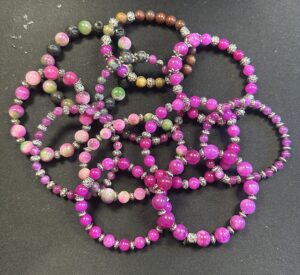
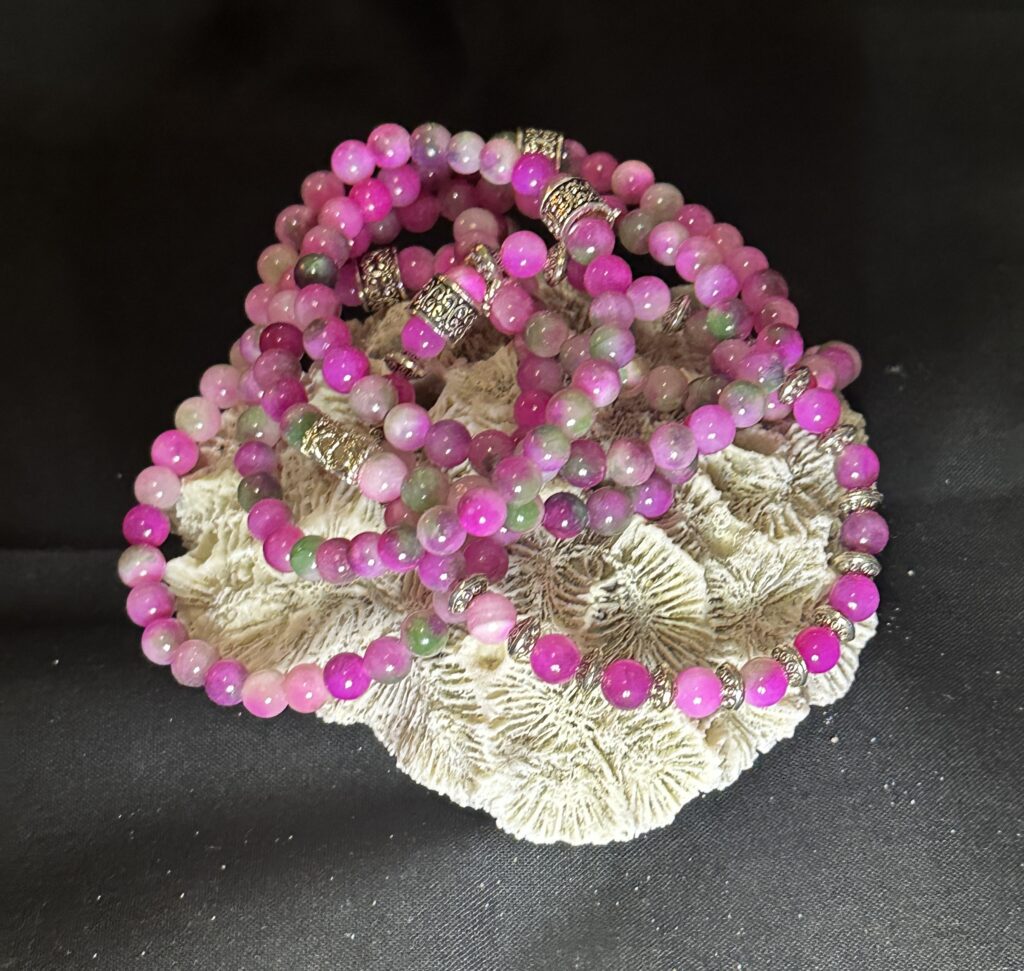
At The Jewelers Bench, pink tourmaline is often used in bracelets intended to feel vibrant yet elegant. Its bright color provides a focal point while allowing surrounding stones to enhance the overall design.
Birthstone and Cultural Associations
Tourmaline is one of the official birthstones for October, along with opal.
Pink tourmaline in particular is often associated with:
• Love and emotional strength
• Compassion and friendship
• Celebration and joy
Because of its rich color and symbolism, pink tourmaline is frequently chosen for meaningful gifts and personalized jewelry pieces.
Scientific and Gemological References
For readers interested in the science and classification of tourmaline gemstones, the following institutions provide detailed resources.
Gemological Institute of America (GIA)
https://www.gia.edu
Mindat Mineral Database
https://www.mindat.org
International Gem Society
https://www.gemsociety.org
Smithsonian National Museum of Natural History
https://naturalhistory.si.edu
These organizations maintain extensive research databases on gemstones, mineral structures, and global deposits.
The Jeweler’s Perspective
From a jeweler’s standpoint, pink tourmaline offers a remarkable combination of color intensity, durability, and individuality.
When selecting stones for jewelry, artisans often look for:
• Rich, even color
• Minimal visible fractures
• Strong transparency or glow
• Consistent bead size and polish
Tourmaline crystals often show natural color zoning, meaning different sections of a single crystal may display slightly different shades of pink.
Rather than viewing this as a flaw, many jewelers appreciate these variations because they reflect the stone’s natural geological history.
Closing Notes
Pink tourmaline is one of the most captivating gemstones produced by the earth’s pegmatite systems.
From its formation deep within mineral-rich magma chambers to its transformation into jewelry worn around the world, the stone represents the intersection of geology, craftsmanship, and personal meaning.
Whether admired for its vibrant color, its geological complexity, or the symbolic interpretations attached to it, pink tourmaline continues to hold a special place in the world of natural gemstone jewelry.